
Beyond the Schedule
Finding the Frozen Cash in Your Practice Workflow
Lisa Landry
4/23/20262 min read

In my two decades managing operations for Fortune 5 organizations like UnitedHealthcare, Liberty Mutual, and McKesson, I learned to identify a specific type of financial drain called operational friction—the invisible gaps where manual workarounds and outdated systems freeze your cash flow.
Many practice owners are currently paying a manual tax without realizing it. Here are three common ways that outdated systems and workflows freeze your cash flow.
1. The Wall of Paper Problem
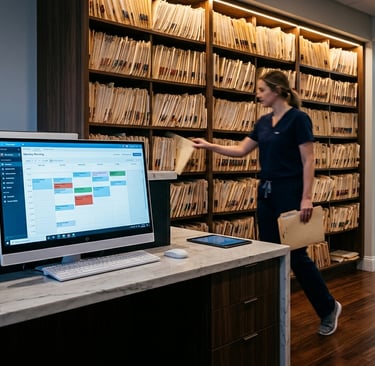
It is common to walk into a beautifully renovated, modern dental building only to see a massive wall of paper files behind the front desk. While this is often viewed as a harmless tradition or a backup system, it is actually manual labor in disguise.
Paper files eliminate the possibility of automation. When a claim is denied or a patient record needs updating, a staff member must physically locate, pull, and refile a document. If an employee spends just five hours a week walking back and forth to a filing cabinet, the practice pays thousands of dollars a year in pure walking wages. The more significant cost is the speed to cash. Paper-based workflows inevitably result in a slower time to payment compared to digital counterparts.
2. The Aesthetics vs. Systems Gap
In an industry that prioritizes the patient's first impression, it’s incredibly easy to over-invest in the 'front of house' while the 'engine room'—the systems—runs on legacy parts.
Many offices operate on a four-day schedule but only reach 60% of their actual capacity because their scheduling processes are manual. These practices pay 100% of their rent and fixed overhead for only 60% of the potential result. By modernizing the schedule and the workflow, a practice can often add 20% to its bottom line without needing to open for a fifth day. The goal is to ensure the engine of the business is as polished as the waiting room.
3. The Insurance Carrier Lock-out
Carrier requirements for security and data exchange are changing rapidly. Organizations now require strict Multi-Factor Authentication and secure portal logins to process verifications and claims. Practices running on operating systems that are a decade old often find themselves locked out of these digital efficiencies.
When a system cannot support modern security protocols, the staff is forced into manual workarounds. A task that should take two minutes through a portal instead becomes a 45-minute phone call on hold with a carrier. In this scenario, a practice is paying clinical-level wages for a staff member to act as a manual interface for a carrier that prefers digital interaction. This technical bottleneck is often the primary reason why insurance aging reports begin to climb.
Finding the Frozen Cash
Operational efficiency is not about buying new gadgets. It is about removing the clogs in your workflow so that your production can actually reach your bank account. By identifying these manual taxes, you can reclaim your staff's time and refocus it on patient care and revenue recovery.
When you align your technology with your strategic vision, you stop running faster just to stay in place. You begin to lead a practice that is as efficient as it is clinical.
Join The Advisor’s Eye
Get tactical financial insights and strategic updates for your practice delivered to your inbox. No fluff, just the insights you need to lead with intention.

Lisa Landry, Strategic Advisor
© 2026 Lilac City Advisory. All Rights Reserved.